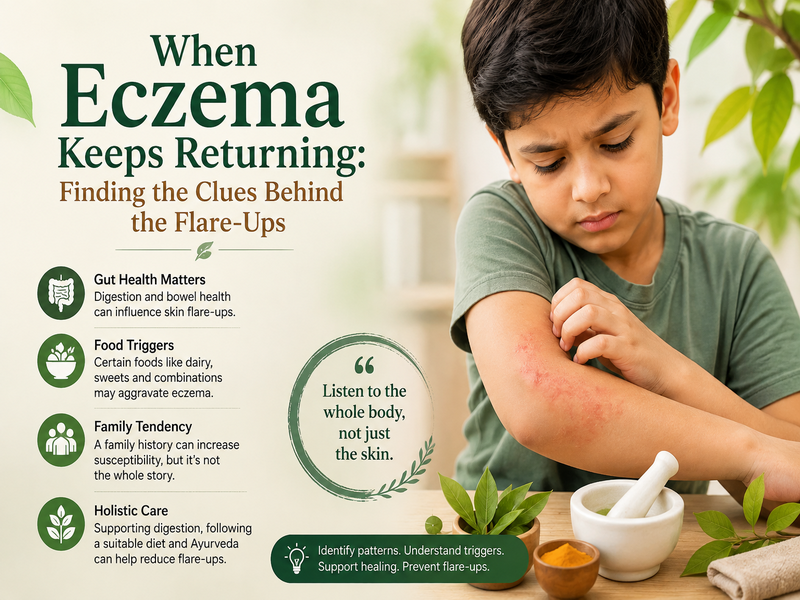
When Eczema Keeps Returning: Finding the Clues Behind the Flare-Ups
For most children, a mosquito bite is hardly worth remembering. For 8-year-old Aarav (name changed), it could be the beginning of another skin flare-up. His mother had watched this happen many times. A small bite or irritation would appear on his skin, only to become increasingly itchy and inflamed. At times, the lesions would even become filled with pus.
This had been part of their lives for years. Aarav had been having these skin eruptions since infancy. His hands, thighs and legs were commonly affected. Treatments would help settle the symptoms, but after the treatment was stopped, the eruptions had a tendency to return.
By the time he came to us, his mother was not simply looking for something to calm the next flare-up. She wanted to understand why it kept happening. And that is where Aarav's story became more than a story about his skin.
There Were Clues Elsewhere
As we sat with Aarav and his family and went through his history, we began noticing a few details that were easy to overlook when focusing only on the skin.
His bowel habits were irregular. He also had anal itching. Then there were his food habits. His family had noticed that certain foods seemed to make his skin worse. Dairy products, sweets and some food combinations appeared to aggravate his symptoms.
There was another detail in his history- a previous episode of food poisoning a few years earlier. It was not something that could explain his eczema by itself. But when we looked at his digestive complaints, bowel pattern and food-related symptoms together, it became another important part of the story.
Then came an important family detail. Aarav's father had psoriasis. In Ayurveda, an inherited tendency towards certain health conditions is described through the concept of Beeja Dosha. In simple terms, it refers to a tendency that may be passed through a family and can make a person more susceptible to certain conditions.
So, his father's history was important. But it was not the whole explanation. A family tendency may tell us that someone is more susceptible. It does not necessarily tell us what is causing the symptoms to flare up again and again.
For that, we had to look at Aarav himself.
The Skin Was Telling Only Part of the Story
The more we listened, the more we saw a connection between his skin, digestion and food habits. This changed the way we approached his treatment.
Instead of concentrating only on the eruptions that were visible, we also focused on supporting his digestion, addressing factors that could be contributing to the repeated flare-ups and calming the inflammation on his skin. Aarav was given medicines to support digestion and reduce the tendency for repeated flare-ups. A suitable medicated oil was also used externally over the affected areas.
His diet became an important part of the plan as well. Foods that repeatedly seemed to aggravate his symptoms- particularly dairy and excess sweets - were removed. Food combinations that did not suit him were also avoided.
The family was given simple dietary and lifestyle changes that could be followed consistently at home. As the active inflammation settled, the treatment was gradually modified according to how Aarav was responding. During the follow-up phase, Takra Dhara, a gentle Ayurvedic therapy in which medicated buttermilk is poured in a continuous stream, was introduced. Later, a rejuvenative (rasayana) medicated preparation was added to support the next stage of recovery.
The Changes Started to Show
Over the next few weeks, the changes became easier to notice. By the fourth week, Aarav had shown around 70% improvement. The itching was much less troublesome, the pus-filled eruptions had reduced, and even his anal itching had improved. But his progress was not just about what was happening on the skin. His bowel habits were beginning to become more regular too.
After 4 Weeks |
After 8 Weeks |
|---|---|
Around 70% improvement |
Around 90% improvement |
Itching had reduced significantly. |
Itching had become minimal. |
Fewer skin eruptions were appearing. |
Earlier lesions had almost completely settled. |
Pus-filled eruptions had reduced. |
No significant new eruptions were seen. |
Anal itching had improved. |
Digestion had improved. |
Bowel habits were beginning to become more regular. |
Bowel habits had also improved. |
One Small Observation Gave Us a Useful Clue
During this period, something interesting happened. After several weeks of improvement, Aarav had a sweet preparation. Soon afterwards, his skin flared up noticeably.
For his family, this was not simply another episode of eczema. It helped them recognise a pattern. We had already noticed from his history that sweets seemed to aggravate his skin, and this episode provided another practical clue that sweets could be one of Aarav's individual triggers.
It was a small observation, but it showed how closely following a child's day-to-day responses can help identify what may be contributing to repeated flare-ups. By the eighth week, the picture was very different. The improvement had reached around 90%. The itching was now minimal. The earlier lesions had almost completely settled, and there were no significant new eruptions. His digestion and bowel habits had improved as well.
The focus was no longer simply on bringing down the next flare-up. It had shifted towards maintaining the improvement and supporting Aarav's overall health.
A Different Way of Looking at Recurrent Eczema
What stood out in Aarav's story was not just the eczema, but the pattern behind it. His skin flare-ups repeatedly appeared alongside digestive and bowel complaints, and certain foods seemed to make them worse. This is where the gut–skin axis becomes important. The gut and skin are closely connected, and changes in the gut can sometimes influence how the skin behaves. So when eczema keeps returning, digestive health may be worth considering as part of the bigger picture; not as the only cause, but as one of the pieces that may matter. Doesn’t mean that one has to be forever on dietary restrictions or elimination diet, rather be on diet till the pre existing inflammation gets treated and healthy tissues are formed, and after that one can be easier on diet, with minimum to moderate caution.
Perhaps the simplest takeaway is to pay attention to patterns. When the skin flares, notice what is happening with digestion, bowel habits and recent food choices. Over time, these small observations can reveal individual triggers that may otherwise go unnoticed. Aarav's journey showed us that improvement was not only about calming the skin. It was about understanding the child more completely.
But what stayed with me was something even more important: sometimes, to understand what the skin is saying, we have to listen to what the rest of the body is saying too.